Key Tariff Updates and Import Compliance Insights

We wanted to share three key trade updates that have been the focus of recent discussions with many of our clients this week. Please review the following information regarding the new Section 232 tariffspotential China tariffs, and a Hot Topic tip on managing steel/aluminum tariffs.

New Section 232 Tariffs on Timber, Lumber, and Derivative Products

Effective October 14, 2025

The U.S. government has implemented new Section 232 import duties affecting timber, lumber, and related products. Below is a summary of the new duty rates:

Softwood Timber and Lumber

  • 10% additional ad valorem rate of duty

Upholstered Wooden Furniture Products

  • From all countries except the United Kingdom, Japan, and EU member states: 25%
  • From the United Kingdom: 10%
  • From Japan: 15%
  • From the European Union: 15%

Completed Kitchen Cabinets, Vanities, and Parts

  • From all countries except the United Kingdom, Japan, and EU member states: 25%
  • From the United Kingdom: 10%
  • From Japan: 15%
  • From the European Union: 15%

Other Kitchen Cabinets/Vanities and Parts (Unfinished or Incomplete)

  • 0% additional ad valorem duty

Exemptions:
Products already subject to Section 232 duties on automobiles and automobile parts remain exempt.
Products subject to IEEPA tariffs also carry certain exemptions, including:

  • Canada and Mexico IEEPA exemptions
  • Reciprocal IEEPA tariff exemptions
  • 40% IEEPA tariff on Brazil
  • IEEPA oil tariffs on India and Russia

Additionally, Chapter 44 subheadings have been removed from Annex II reciprocal exceptions, meaning they are now subject to reciprocal tariffs.

Potential 100% Tariff on Imports from China

The White House has recently threatened a 100% tariff on all imports from China — “over and above any existing tariffs.”

At this stage, no official action has been taken. We are currently in a wait-and-see period until an Executive Order or official Customs announcement is issued.

It remains unclear whether any new tariffs would apply based on the entry date or if exceptions will be made for vessels already on the water prior to implementation.

We will continue to monitor developments closely and provide timely updates as more information becomes available.

Hot Topic: How to Legally Avoid Paying 50% Tariffs on the Entire Invoice Value of Steel/Aluminum Products

Question:
How do we avoid paying Section 232 steel/aluminum tariffs on the entire invoice value if only a portion of the product is made of steel or aluminum?

Answer:
Request that your supplier provides a detailed, itemized commercial invoice that clearly breaks down all cost components, including:

  • Labor costs
  • Packaging
  • Logistics/Transportation
  • Steel or aluminum content (in value)
  • Non-steel/aluminum content (in value)

Only the value of the steel or aluminum is subject to Section 232 steel/aluminum tariffs.

  • Non-steel/aluminum content of the article is subject only to applicable reciprocal tariffs.
  • Labor, packaging, and transportation costs are not subject to any tariffs.

Pro Tip:
The more documentation, the better. Ask suppliers for:

  • Affidavits
  • Bills of material
  • Detailed commercial invoices
  • Supporting photos

Note:
U.S. Customs and Border Protection (CBP) is entitled to request any supporting information needed to verify the breakdown between steel/aluminum and non-steel/aluminum components. Ensure all supporting documents are readily available at the time of entry.

How to Protect Your Business

  • Always work with a licensed U.S. customs broker.
  • Maintain accurate invoices and supporting documentation.
  • Conduct regular compliance audits.
  • Be cautious of overseas forwarders offering “duty savings” schemes-you will be held liable.

Richard Murray & Co. is committed to safeguarding your supply chain. For questions about compliance or to review your customs processes, contact us today.

Trust. Compliance. Protection.

Protect Your Business: The Risks of Using Origin Freight Forwarders for Customs Clearance

Richard Murray & Co., a trusted leader in global logistics and customs brokerage for over 100 years, is alerting importers of finished goods to the increasing dangers of entrusting customs and freight management to overseas freight forwarders. The Issue: Under-Invoicing and Customs Fraud Under-invoicing is a fraudulent practice where the declared value of imported goods is deliberately understated to reduce duties and taxes. While some overseas freight forwarders may offer to “save costs” by managing customs clearance at origin, these practices put U.S. importers at significant risk.

Common Schemes Include:

  • Tampering with invoices to show lower values than what was paid.
  • Double invoicing – one falsified invoice for customs, one real invoice for payment.
  • Failing to declare assists (e.g., tooling, design, engineering support).
  • Manipulating related-party transactions to undervalue goods.

The Consequences for Importers

If discovered, under-invoicing exposes importers-not just the overseas forwarder-to severe penalties:

  • Financial penalties up to triple the underpaid duties.
  • Civil and criminal charges, including potential prison time.
  • Seizure of goods, leading to total financial loss.
  • Loss of trusted trader status, increasing future customs scrutiny.
  • Tax evasion liability, with back duties and interest owed.

How Authorities Detect Fraud

Customs and Border Protection (CBP) and trade enforcement agencies identify fraud through:

  • Value-gap analysis comparing export vs. import data.
  • Market-based pricing checks against fair market values.
  • Whistleblower programs encouraging tips.
  • Audits and document requests requiring importers to prove “reasonable care.”

How to Protect Your Business

  • Always work with a licensed U.S. customs broker.
  • Maintain accurate invoices and supporting documentation.
  • Conduct regular compliance audits.
  • Be cautious of overseas forwarders offering “duty savings” schemes-you will be held liable.

Richard Murray & Co. is committed to safeguarding your supply chain. For questions about compliance or to review your customs processes, contact us today.

Trust. Compliance. Protection.

New Trade Deals, Rising Tariffs, and Deadline Extensions: What August Means for Global Shippers

🚨White House Trade Announcements

President Trump Announces Major Trade Deal with Japan
On Tuesday evening, July 22, President Trump revealed a landmark trade agreement between the U.S. and Japan. Under this deal:
Japan will pay reciprocal tariffs of 15% on certain U.S. imports.
Japan has also agreed to invest $550 billion into the U.S. economy.
90% of profits from these investments will remain in the U.S.
Japan will open key markets to American exports, including cars, trucks, rice, and other agricultural products.

“This is a historic win for the American economy,” President Trump said during the announcement.
🌏 Global Trade Updates

🇮🇩 U.S.-Indonesia Agreement Finalized
Also on July 22, the Trump Administration confirmed a reciprocal trade deal with Indonesia. Key terms of the agreement include:
19% reciprocal tariff structure
Additional details can be found in the official fact sheet

🇪🇺 EU Negotiations Near Conclusion
The U.S. and EU are reportedly on the verge of finalizing a deal that would:
Lower tariffs to 15% on EU imports
Avert a retaliatory package by the EU, which has prepared measures targeting over $100 billion in U.S. goods if no agreement is reached

🇮🇳🇨🇦 India & Canada Talks Ongoing
Negotiations with India and Canada are still in progress. The U.S. is pushing for higher tariffs in both cases, with formal announcements expected in the coming weeks.

🇧🇷 Brazil: August 1 Deadline Looms
Tensions rise as Brazil approaches the critical August 1 deadline. Key issues include:
Outcome of the Bolsonaro trial
The trajectory of ongoing trade talks
The possibility of retaliatory tariffs, which could impact both countries’ economies
🇨🇳 China Deadline Extended to August 12

Negotiations between the U.S. and China remain fluid. As reported by MSN:
“Earlier in the month, the two countries reached a temporary agreement designed to give them time to negotiate a longer-term deal. Under that agreement, U.S. tariffs of 145% on Chinese goods will be reinstated on Aug. 12 if a deal isn’t reached. Chinese tariffs on U.S. goods are expected to rise back to 125% as well.”
A senior Trump official has suggested that this deadline could be pushed back further if negotiations continue to show progress.

Is Your Supply Chain Ready for August 1? Critical Tariff Updates Inside

🚨Tariff Headlines You Should Know

August 1st Tariff Deadline

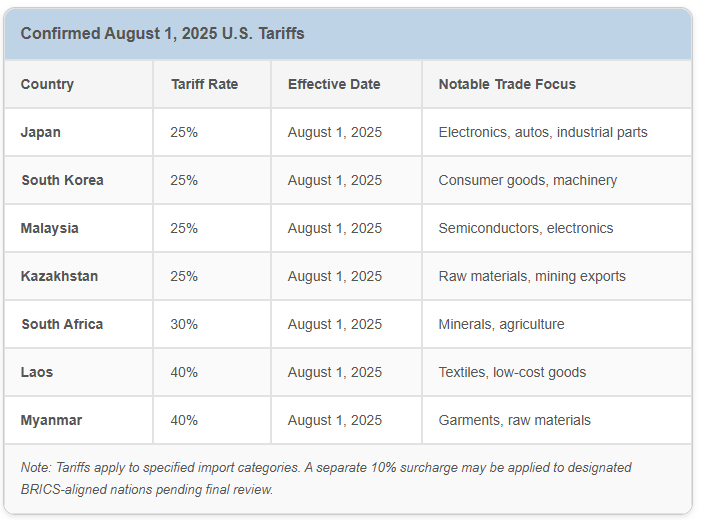
President Trump on Wednesday said he would be sending letters to over 150 countries as he plans a barrage of duties to take effect Aug. 1, including levies on pharmaceutical imports and semiconductors. The letters set new baseline tariff levels at 20% to 40% — except for a 50% levy on goods from Brazil. The tariffs on Brazil have raised the stakes for India. Bloomberg reported on a framework deal that could see US tariffs on goods from India drop below 20%. Last week, Trump announced a 35% tariff on Canadian goods and followed up with promises of 30% duties on Mexico and the EU.  It is still unclear whether USMCA-exempt products will be subject to these potential 35% Canadian tariffs.

The EU has been preparing an extensive list of counter-tariffs that would affect $84 billion of American products should talks fail. Earlier this week, Trump said his team has struck a trade deal with Indonesia that will see goods from the country face a 19% tariff, lowering the rate he had threatened in his letter. Two weeks ago, it was announced that Vietnam imports face a 20% tariff — lower than the 46% Trump threatened in April. With a higher 40% tariff “on any transshipping” — when goods shipped from Vietnam originate elsewhere, like China. As of August 1st a 25% tariff will be reinstated on imports from China, including electric vehicles, steel, and semiconductors.

As of today, it is still unclear whether there will be any time exemptions, but it is expected that all entries will be subject to new tariffs on Aug 1, regardless of whether it was on the water prior to the announcement.

🔍What This Means for Your Supply Chain

Cost Fluctuations: Prepare for potential spikes in customs duties and compliance fees. Short-term rate increases are possible as shippers rush to bring goods in before the August 1 deadline.

Documentation Readiness: Expect enhanced customs scrutiny—ensure all commercial invoices and origin documentation are in order.

Supply Chain Realignment: Companies importing materials from newly tariffed nations may accelerate sourcing shifts toward tariff-exempt countries.

Port Volume Shifts: Certain U.S. ports may see decreased volume on affected trade lanes and increased volume from alternative routes.

Political Uncertainty: Sudden changes in trade policy can create unpredictability for long-term contracting in container, Ro-Ro, and bulk cargo sectors.
Talk With Our Global Trade Experts, We’re here to Help!
Have questions about how tariffs impact your cargo or costs?
Contact us at Info@Richard-Murray.com or call 251-432-5549.
Visit www.Richard-Murray.com to learn more about our network of service.

Thank you for trusting Richard Murray & Co. as your global logistics partner.
We’ll continue to keep you informed and prepared—no matter how trade winds shift.